Is this Your Leadership Moment?

What if the leadership breakthrough you need isn’t so much about learning more tools —but about leading and sharing power from your place of purpose and clarity?  

You’re skilled, committed, making real impact—but something’s shifting. Maybe you’re questioning patterns that no longer serve you or your community, feeling called to lead differently in these polarized times, or sensing a transition ahead. Here’s what I know: you’re not alone. And this restlessness you feel is your own wise self, calling you in. 

Many of us are asking: How do I lead in these volatile times with both strategic skill and deep humanity? How do I stay resilient while doing transformational work? How do I navigate power and build trust across difference?

The Art of Leadership (August 22-27, 2025 at Hollyhock, on Cortes Island, BC) creates space to explore these questions alongside a thoughtfully curated community of change-makers from diverse sectors—Indigenous and local government leaders, health care, social justice, climate action, and mission-driven businesses.

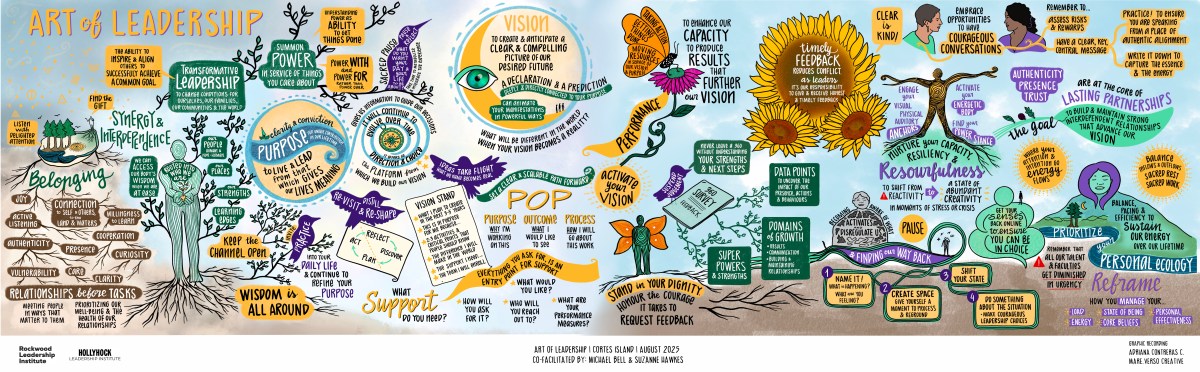
This isn’t just about adding tools to your toolkit—though you’ll definitely get some powerful ones. It’s about strengthening who you are as a leader from the inside out. Over 5.5 days in a stunning oceanside setting with nourishing food and spacious time to think, you’ll deepen six core practices:

  • Purpose: Reconnecting to what truly fuels and guides you
  • Vision: Creating compelling futures that inspire and align others
  • Partnership: Building authentic relationships and having courageous conversations across difference
  • Resourcefulness: Managing triggers and staying centered under pressure
  • Personal Ecology: Sustaining your energy and preventing burnout
  • Performance: Understanding your real impact through confidential 360-degree feedback

This power-informed, equity-centered approach recognizes that effective leadership requires both inner clarity and outer skills. You’ll practice with peers who understand the complexity of creating change—from government leaders navigating bureaucracy to activists working within institutions to entrepreneurs building new models.

“I never knew I was holding so much back out of fear. This training unlocked power and vision within me I didn’t know existed.” —2023 participant

“I’m a BIPOC woman working to address the climate crisis within a large institution. The Art of Leadership provided me the connection, self-reflection and tools to address burnout in myself and my team, and foundational strategies to continue the hard work we need to do.” —2023 participant

“This was the most human training I have ever completed—and I loved every second, even the hard bits.” —2024 participant

These aren’t just nice words—they’re what happens when leaders get the space to remember who they are and why they’re here.

If you’re ready to step into this next chapter of your leadership—not because you’re broken, but because you’re called to more—we’d love to have you join us.

Applications: hollyhock.ca/programs/7450/the-art-of-leadership/
Limited spaces. Some scholarships available.

Tailoring Your 1:1s: Chaudhary’s Coaching Quadrant for Managers

In a recent post, I wrote about reclaiming 1:1 meetings as spaces for growth, trust, and alignment—not just polite check-ins or project updates.

At its heart, managing is largely about coaching. And those regular 1:1s offer a powerful opportunity to practice.

In her recent article, “4 Styles of Coaching—and When to Use Them” (Harvard Business Review, March 18, 2025), executive coach Ruchira Chaudhary shares a beautiful quadrant that managers and employees can use to quickly orient themselves to the most effective coaching approach.

She describes four coaching styles, based on how much push (directive guidance) and pull (open-ended support) a leader brings to the conversation:

  • Telling (high push, low pull): clear instruction and expertise-sharing
  • Hands-off (low push, low pull): stepping back and offering autonomy
  • Asking/Listening (high pull, low push): facilitating self-reflection
  • Collaborating (high push, high pull): blending inquiry with guidance

It’s a powerful reminder: there’s no single “right” way to coach. Skilled leaders shift their stance depending on context, urgency, and the needs and strengths of their team member.

If you’re looking to deepen the impact of your check-ins, Chaudhary’s push-pull lens can be a useful self-check:

Am I showing up the way this person most needs right now? Am I helping them play to their strengths? Am I getting in the way – or too hands-off? What might I dial up—or down—in this moment?

Often, the most effective coaching move isn’t offering advice or solving the problem. It’s creating the conditions for someone to stretch, reflect, and access their own resourcefulness and wisdom.

Chaudhary’s full article is well worth a read—you can find it in Harvard Business Review (March 2025).

Transformative leadership through skilful 1:1 meetings

Some of the core skills leaders share and deepen at the Art of Leadership relate to feedback, courageous conversations, power intelligence and aligning around shared purpose. These powerful competencies might be easy to recognize in the flash of insight gained at a leadership retreat, but they’re truly cultivated through the rhythm of our everyday interactions—particularly in the regular 1:1 meetings managers have with their direct reports.

The humble 1:1 meeting, when approached with intention and presence, becomes a space where the art of leadership is practiced in real time: where listening deeply, showing up authentically, and wielding power with discernment transforms routine management into powerful opportunities for trust, alignment, feedback, and growth.

But let’s be honest: when was the last time one of your 1:1s left you and your direct report feeling energized, aligned, and as though your time was well-spent?

If you’re like many managers, your 1:1 meetings might be drifting into low-lift territory: project updates, surface-level check-ins, or polite conversations that don’t go much deeper than what’s already in your regular project tracking systems.

If you’re newer to managing, you might know these meetings matter — but still feel unsure how to make them count, especially when you’re drinking from the fire-hose of day-to-day demands.

Growth, Not Just Updates

Let’s start here: most organizational effectiveness experts agree that 1:1s should NOT be used primarily (or at all) for project status updates.

Why?

Because status updates are often one-directional, and easily handled elsewhere: shared documents, project management platforms, weekly team meetings, even a simple email.

What 1:1s are uniquely suited for is everything that gets lost in the rush:

  • Unspoken concerns and tensions
  • Coaching and development
  • Celebrating wins and surfacing blocks
  • Asking for — and receiving — real feedback

Power Is Always in the Room

No matter how approachable, friendly and well-intentioned you feel inside, if you’re someone’s manager, you hold positional power.  You likely hold social power, too, based on your seniority, experience, relationships, tenure, and possibly other social identities like gender, race or class.

It is possible, even likely, that your direct report is constantly ‘reading the room’ – wondering what’s safe, or wise, to say; deciding what to hold back, and how to carefully frame what is offered.

It also means we can’t expect honest feedback to flow naturally — or assume that saying “my door is always open” is enough.  It’s not.  

This isn’t about personalities, it’s about formal rank and power, and it is always in the room.  When you’re a manager, you can leverage that power through the design of structures and processes, a growth mindset, and modelling norms and behaviours. If you want feedback from your team, especially the kind that helps you grow, you need to ask for it — and make it safe to give.

Examples:

“What’s one thing I could do differently to better support you?”
“Where might I be unintentionally making your job harder?”
“What feedback have I given that hasn’t landed well?”

And when it comes? Receive it with curiosity and grace — not defensiveness. Your response, both in the moment and over the longer term, teaches people whether it’s safe and worthwhile to be honest with you again.

Small Shifts, Big Impact

Reclaiming your 1:1s doesn’t mean starting from scratch. A few small shifts can have a big impact:

Start with POP

When you, or you and your report, are designing the agenda, use a simple structure to align around shared goals, like POP:

  • Purpose – What is this meeting really for?
  • Outcomes – What would make it useful today?
  • Process – How will we spend our time?

Flip the Script

Let your report lead the agenda. Ask them to bring what’s most important — not just what they think you want to hear. Be sure to track airtime; you should be speaking no more than 50% of the time -ideally less.

Ask Better Questions

Leave room for reflection, insight, and growth. The questions you ask — and revisit — signal what matters, and help surface deeper themes over time:

  • “Where do you feel stuck right now?”
  • “What’s one way you’d like to stretch this month?”
  • “What feedback would be most useful for you right now?”
  • “Where do you see an opportunity to improve how we approach Project X?”
  • “Last month you mentioned wanting to delegate more — how’s that been going?”
  • “You raised a concern about meeting overload — have things shifted at all since then?”
  • “Is there anything we’re not talking about that you think we should be?”

You don’t need to track every thread — but circling back to goals or concerns shows you’re listening, and that these conversations matter. A simple shared doc or a few notes jotted down between meetings can help keep momentum going without over-engineering the process.

The Deeper Why

Done well, 1:1s are more than just meetings. They’re microcosms of the culture you’re trying to build — spaces where power is used with care, where growth is supported, and where trust is earned over time. And those are the kinds of workplaces that can attract and retain top talent and produce transformational results.

Mind the Gap — Why Senior Leaders Need 360 Feedback

As leaders rise in influence, something curious — and dangerous — tends to happen: the feedback gets quieter. And it gets weirder. At the very least, it gets distorted.

People become more cautious in what they say. We filter what we share ‘upward’ – to those we perceive as having more power. And leaders, despite their best intentions, start operating with a partial and possibly inaccurate picture of how they’re actually showing up.

That’s where a confidential 360° feedback process becomes invaluable. It’s one of the few tools that can illuminate the hidden perception gaps that grow with power — gaps between how we intend to lead, and how we’re actually experienced.

I’ve had the privilege of supporting 360 processes with hundreds of leaders across multiple sectors, including as part of the Art of Leadership training in Canada and with the Rockwood Leadership Institute in the USA. Here’s what I’ve learned:

What is a 360 process?

It’s a structured process that gathers confidential, candid feedback from a mix of peers, direct reports, and other close colleagues. Leaders compare this with their own self-assessment, giving them a rare mirror into how others experience their values, strengths, and areas for growth.

Why does it matter?

Research confirms what most experienced leaders already suspect: the higher up you go, the less honest feedback you get. A well-facilitated 360 process helps restore that clarity — and opens the door to intentional, ongoing development.  Author Julie Diamond, one of the world’s foremost experts and researchers on power and leadership, explores this dynamic beautifully in her book Power: A User’s Guide. She outlines how power distorts the feedback loop around leaders — creating perception gaps that make it harder to self-correct.

What does it involve?

A typical process might include confidential, structured interviews of 30-60 minutes or an anonymous written survey with 35 or more questions, covering themes such as strategic efficacy, self-awareness, communication skills, interpersonal skills, conflict competence and more. Themes are synthesized and shared back with the leader in a clear, non-attributed way. The result is a set of insights that are often eye-opening, affirming, and sometimes humbling — but always useful.

How to Get Started with a 360 Process

If you’re curious about trying a 360, here are a few common approaches:

1. Join a leadership program that includes it.

Programs like The Art of Leadership offer 360 feedback as part of a broader development experience, alongside coaching, peer learning, and time for reflection.

2. Work with a certified coach who uses a 360 survey tool

For example:

  • Julie Diamond’s Diamond Power Inventory (DPI) offers deep actionable, behaviour-based insights into how individuals use — or misuse — their personal and positional power. (I’m certified in the DPI and will write more about it in a future post.)
  • Indy Batth is certified in the Leadership Circle Profile, a widely respected instrument used by senior leaders worldwide.
  • Michael Bell, my co-facilitator at Art of Leadership, has created his own rigorous and thoughtful 360 tool used with his most senior clients in multiple sectors

3. Partner with a coach or consultant for an interview-based 360

This is often used with executive leaders and involves 1:1 interviews with peers, reports, and other stakeholders — offering a nuanced, contextual picture of leadership impact.

Each approach offers something different — and all can provide powerful insight when guided by someone thoughtful and experienced.

A few keys to success:

Rater selection: Be sure you – the leader being assessed – are supported in considering your rater selection (who you’ll seek feedback from). You’ll want a mix of ‘cheerleaders’, ‘critics’, and of raters with different kinds of power and rank, relative to yours, including bosses, peers, and ‘subordinates’.

Rater tips: Be sure that the ‘raters’ have some guidance or even training in how to offer actionable, constructive feedback

Don’t go it alone. Successful processes involve training and support about how to skilfully receive feedback, before and during the process. This is vitally important not just for the feedback recipient, but for those around you. People need to feel safe giving feedback, especially to their ‘bosses’, without fear of punishment – or of ‘hurting your feelings’. And you, as a leader, need to be able to skilfully receive feedback with grace, discernment and a clear intention to grow, without feeling crushed – or dismissing the strengths others see in you.

What are your experiences with 360 survey processes – the good, the bad and the ugly?

The Art of Leadership Returns – August 2025

I’m honoured to return this summer co-leading The Art of Leadership — a 5.5-day immersive retreat at Hollyhock, on the beautiful coast of British Columbia, with my long-time colleague Michael Bell. In a time of rising pressure, polarization, and complexity, leadership that is grounded, collaborative, and purpose-driven is more essential than ever.

The Art of Leadership has supported leaders from around the world since the early 2000s. From premiers and mayors to nonprofit executives, public servants, and mission-driven entrepreneurs, participants develop the inner and outer capacities needed to lead with greater clarity, courage, and impact. Originally developed and led by our mentor and friend Robert Gass, this transformative training has been held at Hollyhock and beyond for over two decades, with just a brief pause during the pandemic.

This year’s program runs August 17–22, 2025. Our multiracial leadership team and participant cohort represents a wide range of backgrounds and experiences. Leaders join us from government, nonprofit, business, philanthropy, and social change sectors, creating a rich learning environment where different perspectives strengthen our collective wisdom.

“I’m a BIPOC woman working to address the climate crisis within a large institution. The Art of Leadership provided me the connection, self-reflection and tools to address burnout in myself and my team, and foundational strategies to continue the collective hard work we need to do to address the complex multi-layered problems we face.”

The training blends rich group dialogue, individual reflection, and immediately applicable tools.

Modules include:

  • Purpose: Reconnecting to what fuels and guides you
  • Vision: Articulating a compelling vision that aligns and inspires
  • Partnership: Feedback, courageous conversations, and collaborative problem-solving across differences
  • Personal ecology: Long-term energy management and burnout prevention
  • Resilience: Emotional self-regulation in high-stakes leadership

Participants also receive a confidential 360-degree feedback process from peers, supervisors, and direct reports — a powerful mirror to guide leadership growth.

“The Art of Leadership challenged me to rethink my approach to leadership and provided the tools and insights I needed to grow personally, in order to grow professionally. The course inspired me to lead with greater intention, empathy, and vision, and it empowered me to make meaningful changes in my work and life.” — Participant, 2024

Rooted in decades of practice, The Art of Leadership offers a rare space to reflect, reconnect, and return to your work with more clarity, confidence, and ease.

“Finally, a leadership course that acknowledges, recognizes and even celebrates feelings. This was the most human training I have ever completed – and I loved every second, even the hard bits.” — Participant, 2024

If you’re looking for a reset — time to reflect, learn, and recharge alongside fellow change-makers — we’d love to have you join us.

Learn more or apply here
August 17–22, 2025 | Cortes Island, BC
Hosted by Suzanne Hawkes and Michael Bell

Feel free to share with someone you think would benefit — it tends to fill early.  Some scholarships are available.

Online course: Building Collaborative Teams for High Impact

Building Collaborative Teams_TWHow do you build a collaborative team that can work across difference, adapt to change and unleash their creative potential? I’m thrilled to be teaching “Building Collaborative Teams” as part of Simon Fraser University’s Executive Leadership program, part of Continuing Studies. In addition to the face-to-face offering each Fall, we’re now offering it as an online course starting March 11, 2019, and running for six weeks. Learn with other senior leaders from diverse sectors and organizations.  There are still a few spaces left!  Register soon to save your spot: http://at.sfu.ca/NxSWZK

Coaching for Power Intelligence

header-web-homeOnce again, Anima Leadership in Toronto is offering an outstanding line-up of trainings this Fall.  Given my own focus on power, I’m really excited about participating in one of them next month: a 3-day seminar on “Coaching for Power Intelligence”, centered on developing the effective use of power by leaders using the new Diamond Power Index, developed by Dr. Julie Diamond.  As the Anima team describes it, “this is an essential assessment tool for anybody wanting to correct  leader’s unconscious use of power including: pulling rank, gossiping, bragging, taking credit, fostering unhealthy competition, not taking responsibility, etc. This is the Myers-Briggs of our generation.”   One option is to participate in the first 1.5 days of the seminar.  The entire three-day training covers the background and research underlying the instrument, how to administer the test, how to interpret scores and reports, how to coach and train leaders and leadership teams, as well as marketing support for using it in organizations. Successful completion of the seminar will result in certification for using the assessment

Focusing: Cutting through the clutter to get more done with greater ease

autumn_trees_in_dresdenFor me, Fall always feels like a new beginning. I run faster, breath deeper, and my energy rises with the cooler air and changing colours, even as urgent client demands and exciting new work and learning opportunities start to crowd my inbox. So this is also the time of year when ideas from books and articles on productivity, personal ecology, focusing and habit formation feel especially useful.  Rick Hansen’s wonderful blog was particularly timely today. With ease and simplicity, he describes three ways to focus one’s life energy from week to week and day to day on what matters most: know your purpose; clarify your priorities; and take care of yourself. So simple! Here’s a summary, but read the whole thing, it’s worth it:

Know your purpose in life. Actually write it down. Make sure it’s short, simple, and focused on what you’re for, not what you’re against. Recommit to it daily, even moment to momen – and it can become a source of both energy and discernment.  This is a core piece of the work we also teach at the Rockwood Leadership Institute.

Clarify your priorities. Identify the big goals in your life.  They might relate to the “buckets” or categories of life you’ve identified on a coaching wheel (eg. community service; high performance at work; joyful parenting). Figure out what matters most, then rank each in order of priority. Like your purpose, a short, visible list of your key life priorities can serve as guides for continual discernment and course correction as you navigate what can feel like an avalanche of demands and interests every day.

Take care of yourself.  At Rockwood this connects well to much of our work around Personal Ecology.  Ensure you have the right nourishment – emotionally, physically, spiritually, intellectually – to support staying clear, focused and centered on what really matters to  you. Then you can truly be of service, and present, to others.

“Hire Slow, Fire Fast…”

“Hire slow, fire fast” may be a well-used management cliche, but it deserves repetition. Vu Le’s excellent post today lays out why many managers avoid or delay firing under-performing staff – and why it’s almost never worth it.

Leadership Essentials: Choudhury’s Deep Diversity -Overcoming Us Vs. Them

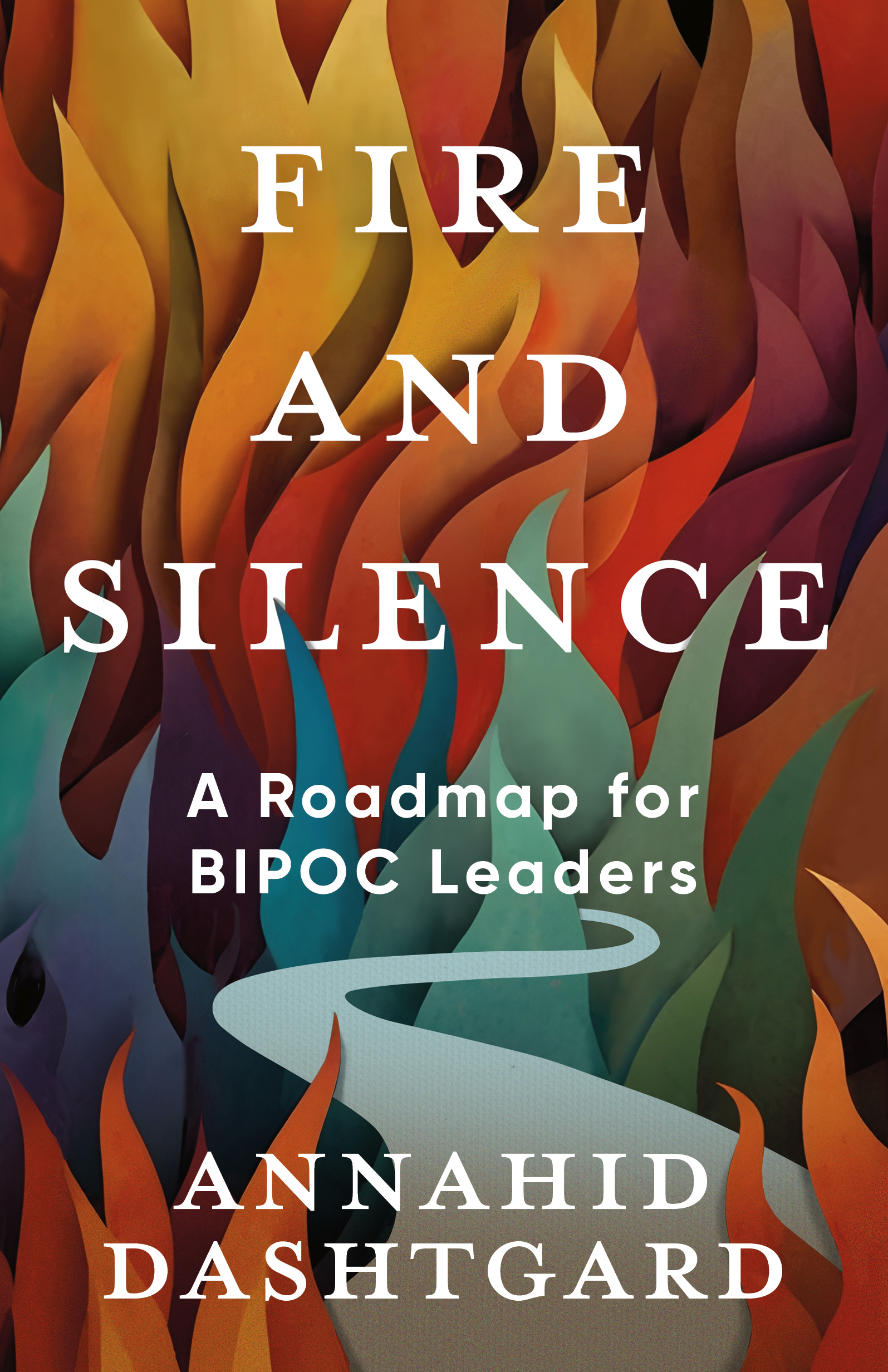
DeDeep Diversity: Overcoming Us vs. Them is hands-down the most useful, accessible book I’ve read on strategies for achieving deep, enduring racial equity at the personal, organizational and community level. Shakil Choudhury writes with the friendly ease and accessibility of Malcolm Gladwell, mixing compelling stories with cutting edge research, ranging from neuroscience to political theory.

It is simply not possible to be an effective leader without not only emotional intelligence, but what Julie Diamond refers to as “Power Intelligence“. Choudhury sets out a clear map for getting there, and welcomes us all to take the journey.  He sets out a four-part framework (emotions; implicit bias; tribes; and power) for understanding and overcoming the devastating effects of racism and marginalization, bolstered by abundant research and his own decades of work as an international leadership trainer, teacher and consultant.

Once we have the awareness of how both unconscious bias and racism play out within ourselves and in the world (yes, racism exists, and it is everywhere; yes, all human brains are hard-wired to both see and respond to difference in ways that are unconscious and instantaneous; and yes, our emotions – not our heads – drive our actual behavior), coupled with the intention to change, Choudhury offers a set of 7 inner skills for shifting our own habits of thinking and becoming potentially powerful change-makers:

  1. Self-awareness – become aware of our own blind spots, unconscious bias, emotions, body language and body signals
  2. Mindfulness – through practice, developing our ability to witness and interrupt unhelpful habits of thinking and replace them with new habits
  3. Self-regulation – develop the inner power and skillfulness to master our own emotional responses, to return from a state of being reactive and brittle (or ‘triggered’) to one of emotional resilience
  4. Empathy – tapping into the human power of empathy to build bridges of understanding, kindness to enlarge the ‘circle of we’
  5. Self-education – actively seeking out stories, data and facts directly, blasting out of well-worn assumptions or reliance on ‘conventional wisdom’ from the dominant culture
  6. Relationship – actively enlarging that circle, personally and professionally
  7. Conflict skills – developing our skills, comfort and ease with conflict – an inevitable by-product of working across difference – so that we can lean in rather than contract or withdraw

Master these skills – and be a brilliant, compassionate and effective leader in any field – a leader that can help unleash the massive collective power and wisdom of diverse teams, organizations and communities.

‘Deep Diversity” is available at most bookstores, through the publisher, or via Amazon.