Is this Your Leadership Moment?

What if the leadership breakthrough you need isn’t so much about learning more tools —but about leading and sharing power from your place of purpose and clarity?  

You’re skilled, committed, making real impact—but something’s shifting. Maybe you’re questioning patterns that no longer serve you or your community, feeling called to lead differently in these polarized times, or sensing a transition ahead. Here’s what I know: you’re not alone. And this restlessness you feel is your own wise self, calling you in. 

Many of us are asking: How do I lead in these volatile times with both strategic skill and deep humanity? How do I stay resilient while doing transformational work? How do I navigate power and build trust across difference?

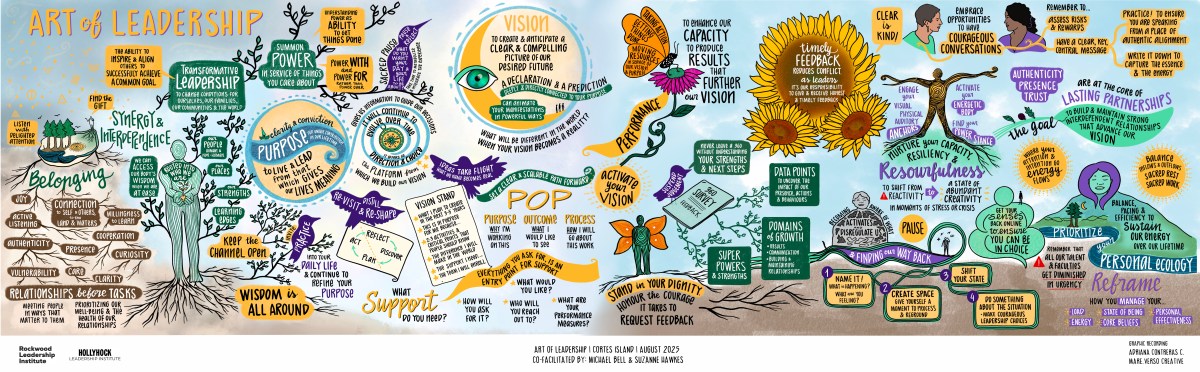
The Art of Leadership (August 22-27, 2025 at Hollyhock, on Cortes Island, BC) creates space to explore these questions alongside a thoughtfully curated community of change-makers from diverse sectors—Indigenous and local government leaders, health care, social justice, climate action, and mission-driven businesses.

This isn’t just about adding tools to your toolkit—though you’ll definitely get some powerful ones. It’s about strengthening who you are as a leader from the inside out. Over 5.5 days in a stunning oceanside setting with nourishing food and spacious time to think, you’ll deepen six core practices:

  • Purpose: Reconnecting to what truly fuels and guides you
  • Vision: Creating compelling futures that inspire and align others
  • Partnership: Building authentic relationships and having courageous conversations across difference
  • Resourcefulness: Managing triggers and staying centered under pressure
  • Personal Ecology: Sustaining your energy and preventing burnout
  • Performance: Understanding your real impact through confidential 360-degree feedback

This power-informed, equity-centered approach recognizes that effective leadership requires both inner clarity and outer skills. You’ll practice with peers who understand the complexity of creating change—from government leaders navigating bureaucracy to activists working within institutions to entrepreneurs building new models.

“I never knew I was holding so much back out of fear. This training unlocked power and vision within me I didn’t know existed.” —2023 participant

“I’m a BIPOC woman working to address the climate crisis within a large institution. The Art of Leadership provided me the connection, self-reflection and tools to address burnout in myself and my team, and foundational strategies to continue the hard work we need to do.” —2023 participant

“This was the most human training I have ever completed—and I loved every second, even the hard bits.” —2024 participant

These aren’t just nice words—they’re what happens when leaders get the space to remember who they are and why they’re here.

If you’re ready to step into this next chapter of your leadership—not because you’re broken, but because you’re called to more—we’d love to have you join us.

Applications: hollyhock.ca/programs/7450/the-art-of-leadership/
Limited spaces. Some scholarships available.

Tailoring Your 1:1s: Chaudhary’s Coaching Quadrant for Managers

In a recent post, I wrote about reclaiming 1:1 meetings as spaces for growth, trust, and alignment—not just polite check-ins or project updates.

At its heart, managing is largely about coaching. And those regular 1:1s offer a powerful opportunity to practice.

In her recent article, “4 Styles of Coaching—and When to Use Them” (Harvard Business Review, March 18, 2025), executive coach Ruchira Chaudhary shares a beautiful quadrant that managers and employees can use to quickly orient themselves to the most effective coaching approach.

She describes four coaching styles, based on how much push (directive guidance) and pull (open-ended support) a leader brings to the conversation:

  • Telling (high push, low pull): clear instruction and expertise-sharing
  • Hands-off (low push, low pull): stepping back and offering autonomy
  • Asking/Listening (high pull, low push): facilitating self-reflection
  • Collaborating (high push, high pull): blending inquiry with guidance

It’s a powerful reminder: there’s no single “right” way to coach. Skilled leaders shift their stance depending on context, urgency, and the needs and strengths of their team member.

If you’re looking to deepen the impact of your check-ins, Chaudhary’s push-pull lens can be a useful self-check:

Am I showing up the way this person most needs right now? Am I helping them play to their strengths? Am I getting in the way – or too hands-off? What might I dial up—or down—in this moment?

Often, the most effective coaching move isn’t offering advice or solving the problem. It’s creating the conditions for someone to stretch, reflect, and access their own resourcefulness and wisdom.

Chaudhary’s full article is well worth a read—you can find it in Harvard Business Review (March 2025).

The Art of Leadership Returns – August 2025

I’m honoured to return this summer co-leading The Art of Leadership — a 5.5-day immersive retreat at Hollyhock, on the beautiful coast of British Columbia, with my long-time colleague Michael Bell. In a time of rising pressure, polarization, and complexity, leadership that is grounded, collaborative, and purpose-driven is more essential than ever.

The Art of Leadership has supported leaders from around the world since the early 2000s. From premiers and mayors to nonprofit executives, public servants, and mission-driven entrepreneurs, participants develop the inner and outer capacities needed to lead with greater clarity, courage, and impact. Originally developed and led by our mentor and friend Robert Gass, this transformative training has been held at Hollyhock and beyond for over two decades, with just a brief pause during the pandemic.

This year’s program runs August 17–22, 2025. Our multiracial leadership team and participant cohort represents a wide range of backgrounds and experiences. Leaders join us from government, nonprofit, business, philanthropy, and social change sectors, creating a rich learning environment where different perspectives strengthen our collective wisdom.

“I’m a BIPOC woman working to address the climate crisis within a large institution. The Art of Leadership provided me the connection, self-reflection and tools to address burnout in myself and my team, and foundational strategies to continue the collective hard work we need to do to address the complex multi-layered problems we face.”

The training blends rich group dialogue, individual reflection, and immediately applicable tools.

Modules include:

  • Purpose: Reconnecting to what fuels and guides you
  • Vision: Articulating a compelling vision that aligns and inspires
  • Partnership: Feedback, courageous conversations, and collaborative problem-solving across differences
  • Personal ecology: Long-term energy management and burnout prevention
  • Resilience: Emotional self-regulation in high-stakes leadership

Participants also receive a confidential 360-degree feedback process from peers, supervisors, and direct reports — a powerful mirror to guide leadership growth.

“The Art of Leadership challenged me to rethink my approach to leadership and provided the tools and insights I needed to grow personally, in order to grow professionally. The course inspired me to lead with greater intention, empathy, and vision, and it empowered me to make meaningful changes in my work and life.” — Participant, 2024

Rooted in decades of practice, The Art of Leadership offers a rare space to reflect, reconnect, and return to your work with more clarity, confidence, and ease.

“Finally, a leadership course that acknowledges, recognizes and even celebrates feelings. This was the most human training I have ever completed – and I loved every second, even the hard bits.” — Participant, 2024

If you’re looking for a reset — time to reflect, learn, and recharge alongside fellow change-makers — we’d love to have you join us.

Learn more or apply here
August 17–22, 2025 | Cortes Island, BC
Hosted by Suzanne Hawkes and Michael Bell

Feel free to share with someone you think would benefit — it tends to fill early.  Some scholarships are available.

7 agreements for productive conversations during difficult times

Here’s some timely advice on working across difference. Sometimes the hardest cuts to bear are from the very people we view as being ‘on the same side’; non-profit blogger Vu Le offers some powerful medicine for prevention and healing. Source: 7 agreements for productive conversations during difficult times

Leadership Essentials: Choudhury’s Deep Diversity -Overcoming Us Vs. Them

DeDeep Diversity: Overcoming Us vs. Them is hands-down the most useful, accessible book I’ve read on strategies for achieving deep, enduring racial equity at the personal, organizational and community level. Shakil Choudhury writes with the friendly ease and accessibility of Malcolm Gladwell, mixing compelling stories with cutting edge research, ranging from neuroscience to political theory.

It is simply not possible to be an effective leader without not only emotional intelligence, but what Julie Diamond refers to as “Power Intelligence“. Choudhury sets out a clear map for getting there, and welcomes us all to take the journey.  He sets out a four-part framework (emotions; implicit bias; tribes; and power) for understanding and overcoming the devastating effects of racism and marginalization, bolstered by abundant research and his own decades of work as an international leadership trainer, teacher and consultant.

Once we have the awareness of how both unconscious bias and racism play out within ourselves and in the world (yes, racism exists, and it is everywhere; yes, all human brains are hard-wired to both see and respond to difference in ways that are unconscious and instantaneous; and yes, our emotions – not our heads – drive our actual behavior), coupled with the intention to change, Choudhury offers a set of 7 inner skills for shifting our own habits of thinking and becoming potentially powerful change-makers:

  1. Self-awareness – become aware of our own blind spots, unconscious bias, emotions, body language and body signals
  2. Mindfulness – through practice, developing our ability to witness and interrupt unhelpful habits of thinking and replace them with new habits
  3. Self-regulation – develop the inner power and skillfulness to master our own emotional responses, to return from a state of being reactive and brittle (or ‘triggered’) to one of emotional resilience
  4. Empathy – tapping into the human power of empathy to build bridges of understanding, kindness to enlarge the ‘circle of we’
  5. Self-education – actively seeking out stories, data and facts directly, blasting out of well-worn assumptions or reliance on ‘conventional wisdom’ from the dominant culture
  6. Relationship – actively enlarging that circle, personally and professionally
  7. Conflict skills – developing our skills, comfort and ease with conflict – an inevitable by-product of working across difference – so that we can lean in rather than contract or withdraw

Master these skills – and be a brilliant, compassionate and effective leader in any field – a leader that can help unleash the massive collective power and wisdom of diverse teams, organizations and communities.

‘Deep Diversity” is available at most bookstores, through the publisher, or via Amazon.

Facilitating an organizational vision: Guided Visualizations

Asian woman dreaming iStock_000015298832XSmallMany visioning processes begin with a guided visualization, where participants close their eyes and listen as they are guided by a facilitator through a series of images and questions. The key is to imagine we have arrived at a specified, fabulous point in the future – where all of our dreams have been realized. It is exactly the way we want it. It is about what we are for – not what we are against. And for most of us, our experience of being in this desired future reality is vivid and visceral. (Note: a few of us experience “visualizations” slightly differently – some of us don’t see pictures in our minds at all. Instead, we see words, or experience a set of sensations.) The experience of imagining that we have arrived at a point in the future – that we are there, right now – can unleash a whole new set of innovative, creative ideas. Click here for a list of 14 questions or elements to weave into your visualization script.

Countering the “Culture of Critique”: The “Yes, and….” exercise

Most of us working on social change are experts at criticism. The problem is when it becomes an unconscious habit in individuals and across entire teams. “Yes! And…” is a classic, fun improv theatre exercise that interrupts this “culture of critique” and helps groups become more adept at embracing new, creative ideas.

man & woman struggle over mic iStock_000001361410XSmall“I can’t believe how hard this is!” exclaimed Vince. “It took all my self-control to not to say “yes, BUT!” The group of civil rights activists, many of them trained attorneys, laughed knowingly. Several had just the same experience. We were sitting in a sunny boardroom in Los Angeles yesterday, debriefing a short exercise we’d just run called “Yes, And…”. If you’re familiar with improvisational theatre or comedy, you’ll know that it’s a powerful training tool, while being highly entertaining in its own right. “Yes! And…” is also one of the most effective, simple exercises I know to help leaders and groups disrupt long-held habits of negative collective thinking in order to generate a more creative, innovative flow of ideas.

The Culture of Critique

Most of us working on social change are experts at criticism. This is particularly true for those of us with academic training, or whose work is focused on advocacy or legal strategies. Through our work as change agents, we learn to finely hone our abilities to rebutt, refuke, counter, critique, denounce and generally point out the shortcomings of other peoples’ ideas. We become so skilled, in fact, that many of our critical tendencies become habits – unconscious, almost knee-jerk reactions to the world around us. And those habits get expressed internally, interpersonally, within organizations and across entire movements. Together, they form what I call a “culture of critique”.

Is criticism necessarily a bad thing? Of course not. The critical, free-thinking minds and imaginations of human beings are among our greatest gifts. Those gifts make it possible to talk about risks, to fight oppression, to influence human systems and behaviours so that we are more just, equitable, collectively intelligent and compassionate.

Criticism has its place. The problem is when it becomes an unconscious habit. It becomes even more of a problem when that habit starts getting routinely expressed across entire cultures.

When critique gets in the way of social change

In fact, the more we aspire to working collaboratively across difference as leaders and movements, the more the “culture of critique” becomes a liability. And it can impede collaborative leadership in several ways:

  • Debate vs. dialogue: Instead of dialogue, we automatically veer toward debate. In conversation, we stop listening, often too soon. The energy becomes more focused on ‘who’s right’ than ‘how can we best move forward’.
  • Missing the full picture”: As Steven Covey says in the 7 Habits of Highly Effective People, the best leaders “seek first to understand, then to be understood”. If we’re immersed in a “culture of critique”, our unconscious habit will be to counter before hearing, or understanding, the full story of another person’s perspective, missing out on important pieces of the whole truth. That means we also miss out on the full spectrum of potential opportunities to move past sticking points into new solutions.
  • Weaker relationships: In the contracted mental and emotional state of “critique”, our focus stayed narrowly confined to our own perspectives, and fails to account for the truths of others. We become less compassionate, less empathetic. The result? Weaker, less trusting partnerships with others.
  • Shutting down good ideas: When others experience critique, they more likely to shut down before their own ideas can fully blossom. Worse, people can become habituated to ‘playing it safe’. They become more likely to avoid sharing risky, innovative ideas that might get shot down as being ‘inappropriate’, ‘stupid’, or befall the idea-purgatory of ‘we already tried that.’

What’s more, all of these effects are compounded when those modeling a habit of criticism hold more institutional, positional, cultural or personal power.

Practicing the “Yes! And…” exercise

As facilitators and leaders, we know that both a desire to do things differently, and a commitment to practice, can help replace less helpful habits with new ones. One of the simplest, easiest exercises I know of as a facilitator is “Yes, And…”. It’s also a terrific energizer, as the results are often hilarious. At its heart, “Yes, And” is about fully accepting whatever someone else shares with you – and then building upon it. Here’s one approach to leading it:

  1. Form pairs. One person is the A, the other the B
  2. A starts by stating something about themselves or the other person… it can be anything at all. If it’s provocative, all the better.
  3. B responds with “Yes! And….”, adding to the statement
  4. A responds with “Yes! And…” and continues building on what B just said
  5. Run the exercise for 3-5 minutes, depending on the energy in the room
  6. Debrief as a large group

Watch out for any urge to counter your partner’s statement, either overtly or through sarcasm. Just keep building. Really, genuinely work with what you’re given!

Here’s an example my colleague Michael practiced with me this week. He was wicked, and we ended up laughing so hard we could barely breath. Here’s how it started:

Michael: So… I hear you’ve become a corporate weapons manufacturer! [I gasp inwardly]

Me: [gulping] Yes, and…. I’m really excited about the opportunity to become an internal agent for positive change in the industry!!

Michael: Yes, and… since I know it’s going to be challenging, I have some relaxation techniques I can recommend!

Me: Yes, and… I’m definitely looking forward to us using them together, since I know you’ve just been hired into the same weapons research division as me!”

Michael: [eyes widening] Yes! And….

And so on. Of course, it can be a lot more serious and “real” than that. The point is to practice disrupting the habit of critical thinking, and building up the habit of embracing and adding to others’ ideas, no matter how weird those ideas may feel.

Want to see a real-time example? Check out this improv theatre training video by Avish Parashar and Fred Gleek.

Applying “Yes! And…” over time

There are two keys to this being really effective in the long-run.

Debrief well: at least for the first time working with a group, make sure there’s enough time to really debrief what it’s like. Where was it hard? In what ways? Did it get easier? How did it feel? What did people notice?

Practice it often. “Yes! And..” is a short, useful energizer in it’s own right, especially during meetings after lunch or when group energy is low. It’s also extremely useful as a “drill” to use before, say, a strategy session, or any kind of collective brainstorm involving at least two people.

Organizational visions: More case studies of great vision statements

goldfish jumping to new bowl-iStock_000020130958XSmallSome of my recent posts describe the power of effective organizational visions, including examples of a few not-so-great vision statements, and one fabulous vision in narrative form. Here are a few more examples of organizational visions that do hit at least some of the notes of a vivid narrative description of an aspirational future. The key: we can see pictures in our minds about what success looks like, and what the organizations are for – not just what they’re against.

We are feeding ourselves, our families, and our community with easily accessible and nourishing food from our local gardens, farmers, and ranchers.
Slow Food Denver

Canadians have confidence in us. Canadian Blood Services provides a safe, secure, cost-effective, affordable and accessible supply of quality blood, blood products and their alternatives. Canada is self-sufficient in blood and we are working to be self-reliant in plasma. Emerging risks and best practices are monitored continuously. Our blood and blood products are safe and of quality…. [the full vision is longer, but you get the point!]
– Canadian Blood Services

Our vision: Provide a world-class Club Experience that assures success is within reach of every young person who walks through our doors, with all members on track to graduate from high school with a plan for the future, demonstrating good character and citizenship, and living a healthy lifestyle.
Boys and Girls Club of Martin County, USA

ForestEthics believes that protecting our planet is everyone’s business. Because of our work, environmentally responsible corporations and governments will thrive. Natural systems will be protected, and the people and wildlife that depend on them will prosper. Markets will be more transparent and ethical.
– ForestEthics

What are YOUR favourite examples of great vision statements? I’d love to hear them! In upcoming posts I’ll share some of the methods I and other facilitators use to help organizations and businesses tap into the power of their own visions.

‘Interpersonal Leadership Styles’ Assessment for High Functioning, Collaborative Teams

flex-iStock_000004490605_ExtraSmall
ILS teaches how to ‘flex’ for different styles

“Wow,” said Robert, looking over at me with a big smile. “They are REALLY loving this!”  Robert Gass, master facilitator and co-founder of the Rockwood Leadership Institute, sat beside co-trainer Gibran Rivera and I in the sunlit meeting room at Devil’s Thumb Ranch, high in the mountains of Colorado. The three of us were watching our hilarious, brilliant colleague, Jose Acevedo, exuberantly leading a group of 24 leaders through a half-day training on Interpersonal Leadership Styles. It is one of the most popular modules in Rockwood’s year-long Leading from the Inside Out program for national non-profit leaders.  Four groups of participants were clustered around flipcharts in in each corner of the room. The energy of each group was remarkably different: some were laughing and punching one another on the shoulders, others were fiercely debating, some pondering silently and gently offering suggestions to one another, as they reflected on their different working styles.  And they were, indeed, loving it.

In fact, I have heard back now from dozens of leaders about the power and impact of having gone through a team-wide training in Interpersonal Leadership styles. Why? People walk away with a keener sense of their blind spots and their strengths as leaders – and of their team-mates’. Rather than feeling judged for those differences, or limited by narrow definitions (something I had feared), it turns out that participants become vastly more appreciative, not just tolerant, of one another’s differences.

The ability to work across difference and to harvest the gifts those differences bring is an essential skill for today’s leaders.  Leaders simply must become adept at recognizing and working with not only differences of power and rank as expressed through race, sexual orientation, class, and ability, but differences in style.  Interpersonal Leadership Styles, or ILS, is an accessible tool that supports this kind of learning. And it offers immediate take-aways in terms of how to flex, even in periods of stress, to make the most of one anothers’ unique perspectives.

Interpersonal Leadership Styles is one of several typologies over the past several decades based on the work of Jung and others, to help map out the different leadership styles individuals tend to bring to their teams. Other typologies you may have heard of include Myers-Briggs, Colby, or DISC. It turns out they are all based on largely the same body of Jungian-based social science research – just packaged differently. But the concept isn’t new. In fact, the Chinese first invented work-related typologies over 4,000 years ago, to help assign civil servants to appropriate roles based on their unique styles and aptitudes.

I and most of my other fellow leadership trainers at Rockwood chose to get certified in ILS because, compared to other systems, we found it simpler to grasp and apply immediately. Most of the sessions I facilitate are between 2.5 and 3 hours, although full-day versions are also offered by many of Stratton Consultants’ licensees.  And while at first I resisted pursuing certification in any such system, I became convinced after repeatedly observing the power of teams who embrace their stylistic differences.

For more information about ILS, contact Stratton Consulting.

“Formula” for writing a compelling speech (or Op-Ed)

Here’s a simple but powerful “formula” for writing a solid speech or op-ed. I’ve adapted it from the framework taught to me by veteran editor David Beers in the context of writing op-eds. It works: in my years supporting non-profits in their media and marketing work, every op-ed I wrote using this basic formula was placed successfully.

The AnnoucementA few months ago my teenaged son was struggling with getting started on a speech for his English class. He had a stack of research notes and a ton of ideas (who knew that a tree sloth can hold its breath underwater for up to 40 minutes?), but was at a loss as to how pull it all together. I explained that early in my communications career, my friend and mentor, veteran journalist David Beers, laid out a simple but brilliant formula for writing op-eds. Over several years helping non-profit leaders create and place op-eds, I found it to be nearly foolproof. Happily, I discovered that the formula is also fantastic for getting started on a compelling speech. And while a beautifully crafted speech defies any pat formula, a simple framework can help get those creative and intellectual juices flowing. So, here’s the basic idea, starting with my own addition: beginning with a story. For the rest of it – apologies to David, as I’ve almost certainly mangled his original sage advice!

Here’s the overview, followed by some detail:

  1. Start with a story
  2. Provoke with a compelling hypotheses or main argument
  3. Back it up with 3-5 supporting points or ‘validators’
  4. Describe the solution or call to action
  5. Circle back to the opening hypotheses (or story)

1. Start with a story…

As virtually every communicator should know by now: start with a story. It could be anything: a personal experience, or one recounted to you; a current news story; a hypothetical or fictional story. As the authors of “Made to Stick” describe so well, stories are “sticky” because they engage an audience’s imagination. When we hear a ‘vivid’ story, we literally see pictures in our minds, and in some ways experience the emotions and physical embodiment of the described experience. This dynamic can transform the audience-speaker relationships. As master communicator and brand strategist, Bill Baker, explains, “starting your presentation with a story helps you break through their cynicism, lower their defenses and get your audience to see you as a person, not just a presenter. In turn, this makes them more likely to connect with you, trust you and listen to you.”

Typically, I encourage speakers to think about a few basic elements: setting and characters (it’s ‘stickier’ to see actual pictures in our minds, not just hear about concepts), some sort of tension or ‘quest’, action, and resolution. There are probably a dozen frameworks or elements taught to help create stories; that’s just one approach. I tend to push the visual. At public speaking trainings for the Center for Progressive Leadership and Simon Fraser University I would ask participants to pair up and tell stories that were so vivid their partners could actually draw something to capture the tale.

Your initial audience engagement doesn’t have to be as rigid as a classic story, however. You could:

  • start with a brief visualization (“picture this: you’re driving along Highway 99, when suddenly…”)
  • ask a question that invites the audience to ponder their own perspective before sharing yours (“How do you discern between a genuine and token apology?”)
  • ask for a show of hands to demonstrate some particular common experience (“how many here arrived by public transit?”)
  • share a powerful quote, or poem
  • read out a topical news headline
  • … or something else

2. Launch into your big compelling hypotheses, position or argument

This is fairly straightforward. What’s your main argument or hypotheses? It should be provocative and compelling in some way. It could just be one statement, like, “When it comes to green tech innovation, Canada is teetering on the cusp of become either a global superstar or an industry laughing stock. Here’s why…”

3. Back it up with supporting points

Next, follow with three to five supporting points or ‘validators’ that back up your main argument. You could transition from the opening position statement above with, “consider this”… then follow with your ‘evidence.’ These supporting points could include statistics, facts, even another story – anything to “back up”, prove or make the case for your key position.

4. Clarify the ‘call to action’

For any kind of social change argument, this is where you lay out the solution: what’s your “call to action”? For whom – who is responsible, and what should they do, exactly? If it’s appropriate, you might also describe the next step. And if there’s a role for the audience to play – even better.

5. Circle back to your opening

Here’s where you wrap it all up with your closing paragraph or statement, circling back to the beginning. Basically, this is where you figuratively say: “Snap! See, that’s why I stand by my argument or position”. It could be a sentence or two related back to your opening story (maybe this is where you roll out the story’s ‘ending’), or your main position, or both.

Beyond the Formula

And again – truly transformational speeches are like works of art – there is no definitive recipe for their creation. For some of the deepest, most powerful resources in the field, check out veteran public speaking trainer Gail Larsen’s Real Speaking site and blog. Gail offers both executive coaching and small-group intensive trainings out of both the US and western Canada (I’ve taken two of her workshops), and her book, Transformational Speaking, is invaluable.